
October 1, 2026
7 min. read
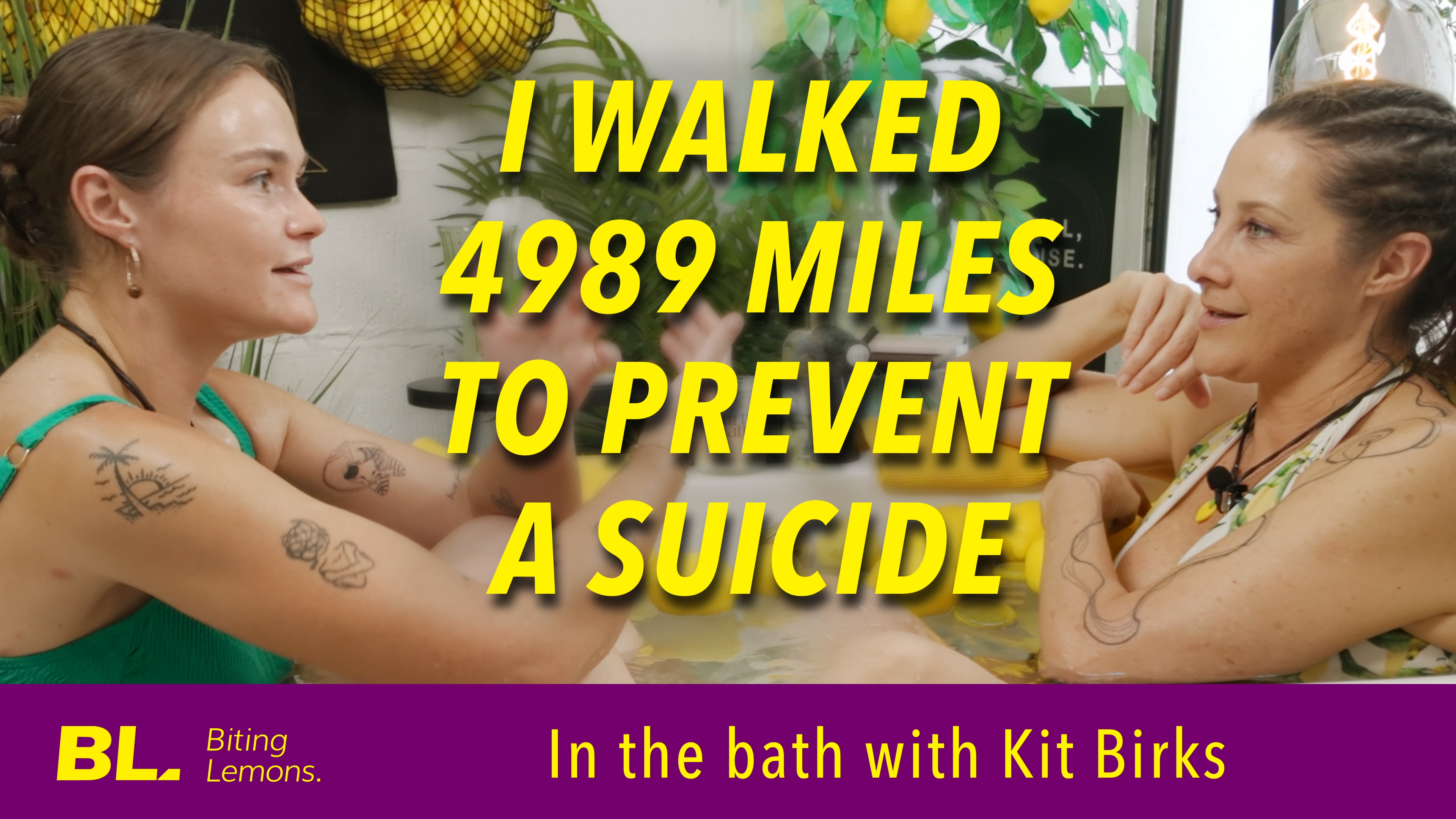
A few months ago, in June, solo adventurer and activist Kit Birks carried her ‘Stride Beyond Silence’ flag to Cape Tripiti, Europe’s southernmost point.
In the video of that moment, she looks small standing on a chair at the edge of the cape. Yet having just become the first person to walk the entire length of Europe alone, she is larger than life.
When Beth interviewed her in the Biting Lemons bath, Kit spoke with the humility that often defines people who dedicate their lives to difficult causes. For her, that cause is suicide prevention: supporting people at the point where every other path has collapsed. It is a cause that touches every aspect of human life.
September was Suicide Prevention and Awareness Month (SPAM) and the Biting Lemons team worked against the clock to film, edit and release the episode with Kit to coincide with this important campaign. We believe in the significance and social impact of all of our episodes, but this one touches upon both the strongest fears and the tiny glimmers of hope in the face of helplessness and loneliness.
One of our core values at Biting Lemons is to help reduce loneliness. We want listeners, viewers and readers to leave feeling supported and aware that change is possible. Kit’s story embodies that intention.
To understand how suicide prevention truly begins, we need to go back to childhood. Prevention often starts too late, when the trigger has already appeared. Traditional approaches rely on predicting crises, but real prevention begins long before that. It begins with early education.
SPAM emphasises recognising warning signs, which requires intuition, empathy and perceptiveness: all skills that can be taught. Awareness alone, however, is not enough. As a society, we have a responsibility to educate children in ways that strengthen their wellbeing in mind, body and relationships.
“We need to do so much more,” Beth urges the government in the podcast and what she means by that is a total reform of the education system and how we educate children from birth up.
“Some of the things I would like to see changed in our education system is for us to be trained throughout school, on how to support lots of different mental health struggles and to be aware of mental health as much as we are about what do you do if you cut yourself,” she says.
This does not mean turning children into therapists. It means raising them with honesty about life’s challenges and empathy for themselves and others.
As Gabor Maté writes in Hold On to Your Kids, children learn best when they feel connected to the adults guiding them. Today’s classrooms often prioritise curriculum over relationships. Teachers manage large groups and heavy workloads, leaving little time for genuine connection.
When children don’t feel seen, they disengage. They lose motivation. They struggle to find meaning in what they’re learning. A recent study in Spain confirms that today’s teens respond better in a positive environment, created by teachers they perceive to be good at managing emotions.
With that said, connection is not a luxury, it is the foundation for every skill that follows. If we want education to play a role in suicide prevention, we must expand what children learn beyond academics.
Mental health literacy
The first and, ultimately, only person who can prevent a suicide is the individual themselves.
According to the WHO (World Health Organization), “suicide is the third leading cause of death among those aged 15–29 years old”. Most incidents are linked to underlying mental health disorders. Globally, one in seven adolescents aged 10 to 19 experiences a mental disorder, accounting for 15% of the global burden of disease in this age group.
Teaching children to recognise when their mental health is declining and to understand that support exists is a foundational step in prevention.
Children are not born with an understanding of distress. They are born expecting to feel safe and regulated. When that sense of wellbeing is disrupted for the first time, they have no framework for what is happening. Adults must provide that framework.
Struggling is a universal human experience. What matters is how quickly a child can identify that something is wrong and take steps towards support. Mental health literacy gives them the language and confidence to do that.
Nervous system awareness
Despite how central the nervous system is to both mental and physical health, many people only learn about it in adulthood. Stress and overwhelm target the nervous system first. When it becomes dysregulated, emotions, coping mechanisms and relationships are affected.
Teaching children to recognise stress cues, shutdown responses and physical sensations associated with distress helps them regulate difficult feelings. Therapists often ask, “Where in your body do you notice this feeling?” because awareness of physical signals is the first step toward regulation. Conversely, if they care for their nervous system, they can make any condition easier to manage.
Children who cannot regulate internal alarm signals are more vulnerable to impulsive behaviours, including self-harm. Dr Dan Siegel’s work shows that emotional regulation skills reduce impulsivity and despair, which makes them a protective factor.
Nonviolent communication
Marshall Rosenberg’s Nonviolent Communication (NVC) teaches people how to express themselves compassionately, even when angry. Young people experience anger frequently and intensely. Without tools to manage it, they may project it onto others, escalating conflict, or internalise it, turning distress inward. Both patterns can be harmful.
Rosenberg developed NVC after experiencing bullying and antisemitic violence as a child. His work focuses on how language can help us stay connected to our compassionate nature, even under difficult circumstances. For children who are bullied, NVC offers a way to name their needs clearly and seek support without shame. For children who might have a tendency to express themselves through aggression, it provides a framework for understanding their own unmet needs and learning alternative ways to express frustration.
When children learn to express needs clearly, listen without defensiveness and recognise the emotions behind behaviour, they build healthier relationships and reduce conflict. Improved communication reduces bullying, making it another major protective factor against suicide.
Rupture and repair
Relationships break. Teaching children this early prevents confusion, bitterness and hopelessness later in life.
According to the European Commission, one in five children in 2024 reported feeling chronically lonely. Loneliness is one of the strongest predictors of suicidal ideation.
Loneliness can come from a lack of relationships, but it can also come from rupture, such as parental divorce or friendship breakdowns. Children need to understand that some ruptures cannot be repaired and that this is part of life. They also need to learn how to repair relationships that matter.
Rupture and repair, together, teach children that recovery is possible. They build resilience and reduce the belief that conflict equals abandonment.
Media literacy
Children today navigate a digital environment that is complex and often unsafe. Social media algorithms, misinformation, comparison culture and AI-driven cyberbullying create risks that are difficult for adults to monitor.
Media literacy helps children understand how online environments work, how to distinguish curated content from reality and how to report harmful behaviour. It also encourages them to seek support rather than hide distress.
In addition, when they know they will be met with understanding rather than shame, children are more likely to reach out when something online harms them.
Life skills
Life skills (cooking, budgeting, navigating bureaucracy, understanding contracts, caring for a home) contribute directly to wellbeing. Without these foundations, adulthood feels chaotic and overwhelming.
Research shows that life-skills education increases independence and reduces stress in early adulthood. Stress, when unmanaged, can compound into hopelessness. Teaching children practical skills gives them a sense of competence, which protects against despair.
A child who feels capable becomes an adult who feels less threatened by life’s demands.
Self-advocacy
Self-advocacy is the ability to express needs, set boundaries and ask for help. Many adults struggle with this, which is why teaching it early matters.
Children who learn to say “I need help” or “I don’t feel safe” are more likely to seek support during distress. Research shows that self-advocacy reduces the impact of bullying and promotes help-seeking behaviour.
Children who advocate for themselves grow into adults who do not suffer in silence.
Rest literacy
Since the pandemic, many young people have grown up in environments defined by pressure, instability and constant comparison. Workdays stretch late into the evening. Hobbies become competitions. Rest feels undeserved.
A lot of young adults who grew up over that period are now striving for the world’s approval, jobs in a crippling market and a piece of the career ladder cake. There is rarely a break.
Teaching children how to rest — genuinely rest — is essential. Rest literacy means understanding that slowing down is not failure. It is part of being human. It means learning to pause, breathe and engage in activities without performance or productivity attached.
Rest supports nervous system regulation, emotional stability and connection. It is as important as any academic or professional skill.
In many ways, Kit’s walk across Europe is the perfect metaphor for what real suicide prevention requires: long, patient, steady steps. She carried her flag across a continent to show that silence can be broken. Our responsibility is to carry that message into classrooms, homes and policies, so that the next generation grows up with the tools to stay connected and hopeful long before they ever need them.
share & comment on