
October 1, 2026
9 min. read
There are conversations we tiptoe around without ever naming the reason. Sometimes it’s fear, sometimes shame, sometimes the hope that if we don’t look at something, it won’t look back.
The title of this article is, to put it simply, the essence of the Biting Lemons podcast. The lemons are the difficult topics that we dare to bite with each episode, releasing all that shame, guilt, grief, trauma and, in fact, kindness to the world. We try to feed minds by opening discussions, challenging taboos and planting questions that might otherwise go unanswered.
Beaver Meadow knows this terrain intimately. She has looked directly at the “something” most people spend their lives avoiding and endured it looking back at her. That “something” is her trauma. That “something” is being a child incest survivor, a term she insists on naming without euphemism.
Beaver has faced all the truths of that past and, as she herself puts it in one of her Medium essays, “transformed it”, “made something sacred out of something stolen”. She quickly follows it up with: “But let’s be clear: the fact that I made meaning from my trauma does not mean the trauma was ever okay.”
Alongside the unpaid, instinctive labour of activism, Beaver also did therapeutic sex work. No euphemism here either. Her role centred on supporting people with disabilities or emotional barriers around intimacy, helping them build confidence, understand consent, receive it, give it and take pride in an act that brings pleasure, connection and mental well-being.
Among her clients was a man funded by the NHS to receive care in her hands: an astonishing accomplishment for practitioners in her field and, albeit small, acknowledgement that her work makes a positive difference in someone’s life.
Yet, people like Beaver, with her background and a past she has no control over and cannot erase, get silenced. Her story is treated as something volatile that might unsettle the wider world if spoken aloud. Many deem her past “too much”, not out of malice, but out of discomfort and a lack of understanding.
Why is it difficult to ask Beaver, what do you feel when you think about your childhood? What is the present of an incest survivor?
Why can’t we just talk about it?
Before dissecting the ‘why’, let’s establish that, as humans, we are wired to turn away from things that feel threatening and uncomfortable. There’s a reason the word ‘unspeakable’ exists.
When I say wired, this implies physiological, cultural and personal wiring. Our emotions are always a reaction to the environment around us. When we flinch, it’s because our reflex tells us to protect ourselves from a threat. That threat can either be real and tangible or imagined but deeply ingrained in us by previous experiences.
From a physiological standpoint, people avoid certain topics because they evoke a reaction in their body that they do not associate with safety. A single word, such as, in this case, incest, can feel like a punch to the gut, a throat lump or tight shoulders. It can take the shape of a clenched fist, cold sweat on the small of the back or restless legs.
These expressions are the signals through which the nervous system sends alerts. Stephen Porges terms this ‘Polyvagal Theory’: the nervous system’s reaction to certain topics as if they’re dangerous, even when they’re not.
It can happen outside the conscious mind, subservient to cues that tell the heart rate to quicken and the muscles to tense. A harmless situation turns into a threat.
Okay, you will say, but this applies only to people whose past resembles the trigger in question, victims. Why do others, who have not personally been through such an experience, turn away?
This is where cultural wiring comes. On the one hand, there’s the societal expectation that topics that make common people uncomfortable or upset do not have a place in polite conversations and the public domain. We don’t talk about this in school. We don’t talk about this at work. In the supermarket, we only exchange a couple of quiet comments in empty aisles. When you shrink the space available for discussion so much that it cannot escape the private home, you sentence it to avoidance in the public consciousness.
American psychiatrist Judith Herman, whose research focuses on the understanding of incest and trauma, puts it bluntly: “The ordinary response to atrocities is to banish them from consciousness. Certain violations of the social compact are too terrible to utter aloud.”
Then, there’s the personal wiring of our understanding, which concerns our subjective experience. We avoid conversations because we are not ready to face a part of ourselves that we might not have processed.
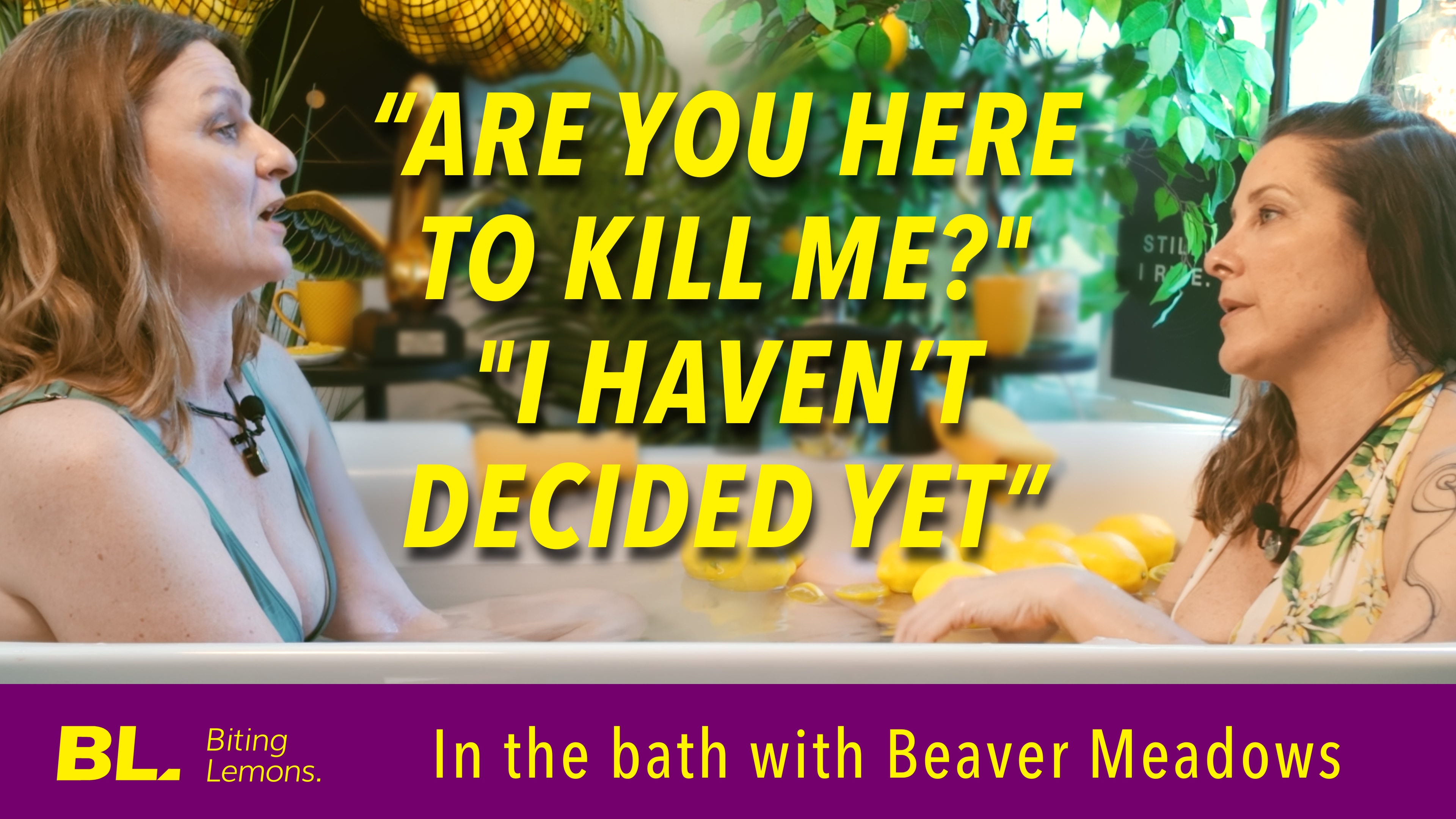
Halfway through the episode, Beth, echoing the thoughts she believes listeners of the podcast might form, says that Beaver sounds rather blasé revisiting her childhood. How does one speak about surviving incest as a child with such composure and a golden statue of a penis next to them (for context, watch the episode)?
Beaver’s response sounds simultaneously enlightening and simple: “For me it’s just really important that I’m authentic and I just say it as it is.” In other words, “I am not a trigger”.
Hearing this induced guilt in me: the collective guilt of a society that silences victims because it finds their experience repulsive. There is empathy, but only when not asked for, at an arm’s length, enough to tap the crown of the head and say: “Oh, poor you!” It often ends there, without asking the questions that a victim might want to answer in advocacy.
In an interview with The Walrus, Herman touches on the role of the bystander. For many survivors, the greatest pain comes not from the abuser, but from the inaction of bystanders.
“Jennifer Freyd, who is a psychology professor and also a survivor, talks about how institutional betrayal, for example, when colleges fail to believe and support victims of sexual assault on campus, in many ways, hurts as much or even more than the betrayal of the offender,” Herman says.
This makes me wonder why people get offended by stories that have nothing to do with their own lived experience. There’s a complexity to that reaction.
Part of it comes from tribalism and the idea that the pain of one can be felt by the whole. It comes from vivid imagination and the capacity to experience pain vicariously. Through this reaction, people express that their idea of what the world should be has been broken.
Taking offence also derives from a lack of emotional literacy. Few of us are taught as children how to sit with complexity and discomfort, having an entire village around us ironing out every crease to “help” us live a safe life.
By the time we reach adulthood, any recognition that difficult conversations matter is far gone.
The value of holding difficult conversations
So far, I have rarely mentioned the role of the perpetrator, because my focus is the aftermath of abuse, and I don’t want to give them the time of day too much. I do think, however, that it’s important to understand the relationship between the abuser and the bystander.
The first and probably most fundamental reason for giving a platform to such conversations is that silence only protects the perpetrator, not the survivor.
Closely following is the understanding of what taboo means. Taboo topics do not emerge out of thin air, already clothed in shame and shushed voices. Once upon a time, we created them in agreement that they are incompatible with a peaceful existence because they disturb our order.
From this, we can derive that a conversation is difficult because someone has decided it is. To use a common psychological dilemma, why does the child that sees a bear know to fear? “When we encounter the bear, we already have an impression of the risks of the encounter, as an impression that is felt on the surface of the skin,” Sara Ahmed writes in The Cultural Politics of Emotion.
On a fully health-related note, letting difficult emotions out into the world can be life-saving. Research after research (and my therapist) says that bottling up emotions hits you right in the stomach, making it prone to ulcers. Throbbing headaches are stress’s favourite playground.
In his work on the effects of trauma, physician Dr Gabor Maté cites numerous studies that prove that “compulsive positive thinkers are more likely to develop disease and less likely to survive”.
“Genuine positive thinking, or, more deeply, positive being, empowers us to know that we have nothing to fear from truth,” he writes in The Body Says No. Our instinct is to believe that the truth will make us ill when, in reality, hiding it is what damages the mind and, slowly but surely, the body.
Maté consistently encourages parents and teachers to foster emotional competence in children, so that they grow up empowered to address stress, anger and shame and heal quickly from disturbing experiences. Considering we don’t live each in a bubble, all of our experiences involve people and healing, therefore, requires conversation.
Another strong propagator of the link between trauma, stress and physical health, Bessel von der Kolk writes that “trauma victims cannot recover until they become familiar with and befriend the sensations in their bodies”.
For this to happen, however, they need the support and trust of those around them. “Restoring relationships and community is central to restoring well-being,” he writes. For him, communicating one’s experiences to the world is what moving forward means.
Stories that are difficult to hear educate us on human complexity and save us from naivety. I work in news, so I am the first to say that, in order for me to preserve myself, I need to sometimes detach from the list of misfortunes I write about. Positive stories are a lifeline.
At the same time, however, let’s remember that, in order for everybody to have a positive story, we need to first enable them to speak about the negative experience that has changed or completely defined their identity so they can restore, reset and build autonomy. Only then can they embrace new positives.
The question remains, however: how do we, as part of the environment surrounding them, initiate or join these difficult conversations? With the principles of, first and foremost, safety, trust, empowerment and collaboration.
The Biting Lemons approach is to consistently ask guests to define and explain terms they are familiar with in simple words so that people who have never dabbled in such topics can feel included. It is to ensure that a listener’s first reaction is not to look away and ignore, but to want to learn more.
A conversation is never fruitful if one of the participants feels constantly overlooked and the other feels patronised for not knowing enough about the topic. This doesn’t build safety, which relies on the empowerment to ask kind questions and speak one’s truth.
Trust is built with honesty. Our belief in the podcast is that people should not hide how they feel. You will often catch Beth sharing with guests that her instant reaction upon hearing something they say is to ask questions, change the topic or not face what is rising in her. This is what it means to name your human emotions. What matters is what she does after that: ask more, hold space and overcome the fear of hearing more.
When we choose to stay with difficult stories instead of turning away, something subtle shifts. We begin to understand that discomfort isn’t a warning to retreat but an invitation to expand our attunement to one another. Conversations like the one with Beaver remind us that facing what feels unsettling is about making room for connection and healing. We might find that the very things we fear looking at are the ones that teach us how to be more human with each other.
share & comment on